
Cosmopolitan
Classic Cocktail
A modern classic vodka cocktail that balances citrus brightness, orange liqueur, and controlled cranberry for a crisp, clean finish. The goal is elegance, balance, and a pale pink presentation rather than a heavy, overly sweet drink.

Method & Technique
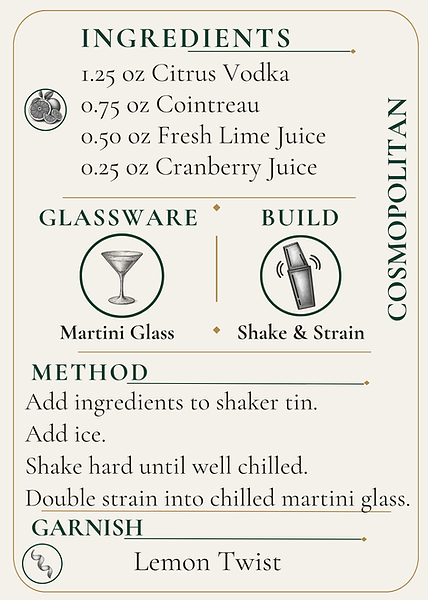
The Cosmopolitan should be treated as a properly shaken sour-style cocktail in which fresh citrus, temperature, dilution, straining, and cranberry restraint determine the finished quality.
Add the measured citrus vodka, orange liqueur, fresh lime juice, and cranberry juice from the house specification to a shaker tin. Fill with sufficient cold ice and shake firmly until the cocktail is thoroughly chilled, integrated, and properly diluted.
Strain immediately into a properly chilled coupe or Martini glass. Fine straining may be used according to the house standard to remove small ice fragments and excess citrus pulp, producing a cleaner texture and presentation.
Finish with the written house garnish. A lemon twist reinforces the drink’s bright citrus profile. An orange expression connects naturally to the orange liqueur and reflects the presentation popularized by Dale DeGroff. Either can work, but the house should establish one standard rather than leaving garnish to random bartender preference.
Cranberry should be measured rather than poured by eye. Its job is to create a delicate blush and supporting fruit note. Excess cranberry darkens the cocktail, increases sweetness, buries the citrus, and moves the drink toward a basic vodka cranberry.
The finished Cosmopolitan should arrive very cold, cleanly strained, pale pink, and balanced between vodka, orange, lime, and cranberry.
Related Core Methods
- Shaking Method
Garnish / Citrus Expression Method
Straining Basics
Guest Story
The Cosmopolitan is a strong recommendation for a guest who wants something cold, bright, citrusy, lightly fruity, and polished without moving into a tropical or overly sweet style.
A useful description is:
“It’s a shaken citrus-vodka cocktail with orange liqueur, fresh lime, and just enough cranberry to give it a light pink color and subtle fruit character.”
The drink is familiar and approachable, but a properly made version should still feel crisp and structured. It works well for guests who enjoy citrus-forward vodka cocktails, Kamikazes, Lemon Drops, or Margaritas but want something served up with a slightly softer fruit profile.
Do not describe it as simply sweet or cranberry-forward. The best Cosmopolitan leads with citrus, while cranberry supports the finish.
Its cultural story can also be useful in guest conversation. The drink developed through several bar communities in the 1970s and 1980s, became fashionable in New York before Sex and the City, and then gained enormous international visibility through the show. If a guest credits one bartender with inventing it, the most accurate response is that several legitimate claims exist, while Toby Cecchini is most strongly associated with establishing the modern fresh-lime version.
For the bartender, the Cosmopolitan teaches restraint and balance. For the operation, it remains valuable because it is globally recognizable, broadly approachable, and capable of being executed quickly without sacrificing quality.
Where It Came From
The Cosmopolitan did not emerge from one completely uncontested moment. Its history is a chain of related pink vodka drinks that moved through several cities, bartenders, and social communities before settling into the modern formula recognized today.
One early claim comes from bartender Neal Murray, who said he combined vodka, triple sec, Rose’s lime, and cranberry in Minnesota in 1975. Versions built around vodka, orange liqueur, sweetened lime, and cranberry later circulated through gay bars and hospitality communities in Provincetown, Cleveland, and San Francisco. Those drinks established the basic idea of a pink, Martini-style vodka cocktail before the polished modern specification appeared.
Cheryl Cook has a separate and well-supported Miami Beach claim. She said she created and named a Cosmopolitan at The Strand in 1989 using the newly introduced Absolut Citron, triple sec, Rose’s lime, and enough cranberry to make the drink pink. Her version was popular in South Beach and became connected to the era’s flavored-Martini culture.
In New York, bartender Toby Cecchini encountered an existing pink drink called the Cosmopolitan through the San Francisco-to-New York bar network. At The Odeon in the late 1980s, he rebuilt it using Absolut Citron, Cointreau, fresh lime juice, and cranberry juice. That fresh-citrus formula became the clearest foundation for the modern Cosmopolitan most bartenders recognize today.
Dale DeGroff later developed and served his own version at the Rainbow Room, famously finishing it with a flamed orange peel. DeGroff has not claimed to have invented the cocktail, but his presentation, media exposure, and influence helped establish a widely accepted upscale standard.
The drink was already popular in New York before appearing on Sex and the City. The television series did not create the Cosmopolitan, but it transformed the cocktail from a fashionable bar order into an international symbol of late-1990s city life, independence, friendship, and style.
The most accurate bartender explanation is that the Cosmopolitan evolved through several related drinks and credible contributors. Cecchini is most closely associated with establishing the recognizable modern fresh-lime formula, while other bartenders and communities played meaningful roles in its development and spread.
Bartender Notes
- Fresh lime juice is essential. It provides the acid structure that keeps the orange liqueur and cranberry from becoming heavy. Bottled lime juice, Rose’s lime, gun sour, or powdered sour may belong to earlier or lower-quality versions of the drink, but they do not produce the clean modern LMA standard.
Keep cranberry controlled. The Cosmopolitan should show a blush of pink rather than a dark red color. Cranberry is an accent for color, mild fruit, tartness, and tannin—not the main mixer.
Cranberry products are not interchangeable. Cranberry juice cocktail is sweeter and generally closer to the profile used in the familiar modern drink. Unsweetened 100% cranberry juice is substantially more tart and concentrated and will require a rewritten specification rather than a direct one-for-one substitution.
Use a quality orange liqueur and measure it accurately. It provides much of the cocktail’s sweetness, so changing brands or quantities can materially shift the balance.
Citrus vodka is part of the drink’s best-known modern identity. Unflavored vodka can still produce a good Cosmopolitan, but it creates a more neutral version and may require adjustment depending on the orange liqueur, lime, and cranberry being used.
Do not judge the drink by color alone. A pale Cosmopolitan can still be unbalanced if it lacks lime, proper dilution, or enough orange liqueur. Color is a useful visual checkpoint, not a substitute for tasting and written specifications.
The Cosmopolitan should be taken seriously. Its popularity and cultural associations do not make it an inferior cocktail. Poor versions are usually the result of too much cranberry, weak citrus, cheap modifiers, warm glassware, or careless shaking—not a flaw in the drink’s underlying structure.
Deep Dive
The Cosmopolitan is often misunderstood because poor versions became nearly as famous as the cocktail itself. When cranberry is over-poured, fresh lime is removed, or sweetened sour mix replaces real citrus, the drink becomes a sugary vodka-and-juice combination. In a disciplined bar program, it is a balanced modern sour.
The Cosmopolitan family tree
The modern drink did not appear in isolation.
The Kamikaze supplied the basic structure of vodka, orange liqueur, and lime. The Cape Codder contributed vodka and cranberry. Earlier pink Cosmopolitan versions effectively brought those ideas together, often using Rose’s lime or grenadine.
Toby Cecchini’s important contribution was not simply adding cranberry to vodka. He rebuilt an existing pink drink with the ingredients The Odeon was using for fresh Margaritas: citrus vodka, Cointreau, and fresh lime juice, with cranberry used for color and supporting flavor.
This explains why the Cosmopolitan should drink more like a vodka sour than a cranberry highball.
The major historical claims
Neal Murray claimed an early 1975 version using vodka, triple sec, Rose’s lime, and cranberry. His account is part of the drink’s credible early history, although it was not the polished fresh-lime formula now widely recognized.
Cheryl Cook described creating an independent Miami Beach Cosmopolitan in 1989 with Absolut Citron, triple sec, Rose’s lime, and cranberry. Her story has supporting witnesses and strong local documentation.
Toby Cecchini rebuilt a circulating version at The Odeon using Absolut Citron, Cointreau, fresh lime, and cranberry. His formulation became highly influential throughout downtown New York and is the strongest claim for the recognizable modern recipe.
Dale DeGroff encountered the drink later, refined his own version, introduced the flamed orange garnish, and helped give the Cosmopolitan premium-bar and media visibility. He popularized rather than claimed to invent it.
These accounts do not all need to cancel one another. The Cosmopolitan appears to have evolved through overlapping communities and independent adaptations before one polished formulation became dominant.
Citrus vodka versus unflavored vodka
Citrus vodka is central to the modern late-1980s identity. It reinforces the lime and orange components and gives the drink a more integrated citrus profile.
Unflavored vodka makes a leaner and more neutral Cosmopolitan. It is a legitimate house choice, particularly when the bar wants greater control over the citrus character, but the resulting drink may not taste identical to the best-known modern version.
A split of citrus and unflavored vodka can also work, but that becomes a written house variation rather than an improvised substitution.
Cranberry selection and control
Cranberry is the easiest ingredient to misuse.
Too much cranberry makes the drink dark, sweet, and flat. Too little may leave the cocktail visually colorless and remove the small amount of fruit and tannin that distinguishes it from a basic citrus-vodka sour.
The exact product matters. Sweetened cranberry juice cocktail, unsweetened cranberry juice, white cranberry juice, cranberry concentrate, and house cranberry cordial all behave differently. Any product change requires tasting and possible rebalancing.
The correct target is not one universal shade of pink regardless of ingredients. The target is a measured, balanced drink in which cranberry remains clearly secondary.
Fresh lime and sweetness
Fresh lime is one of the main dividing lines between a polished Cosmopolitan and a weak one. It provides freshness, tension, and enough acidity to balance the orange liqueur and sweetened cranberry.
Because orange liqueur and many cranberry products both contribute sugar, the Cosmopolitan normally does not require additional simple syrup when the written recipe is properly balanced. Adding syrup automatically can make it heavy.
Acidity changes from lime to lime. The bar should maintain a written specification but still taste ingredients and understand the target result rather than assuming every batch of citrus behaves identically.
Shaking, dilution, and presentation
The Cosmopolitan must be shaken because it contains citrus and juice. Shaking chills, dilutes, and integrates the cocktail while creating the clean, lively texture expected from a sour served up.
Under-shaking leaves it warm, sharp, and disconnected. Excessive or careless shaking can over-dilute the drink and leave too many ice fragments if it is not strained properly.
The serving glass should be thoroughly chilled. The drink has no ice after service, so its temperature begins rising immediately.
A Cosmopolitan should look sleek and composed. Pale pink color, clean glassware, appropriate fill level, and a deliberate citrus garnish all reinforce the drink’s polished identity.
Garnish
A lemon twist is historically connected to the modern Odeon-style drink and emphasizes brightness.
A flamed orange peel became strongly associated with Dale DeGroff’s Rainbow Room presentation. The technique contributes warm orange oil and visual theater, but it should only be performed safely and correctly. A badly executed flame adds risk without improving the drink.
An ordinary expressed orange twist is a practical alternative when the house wants orange aroma without tableside flame.
The house should choose a garnish that supports its style and train it consistently.
Service standard
A strong Cosmopolitan is not great merely because it is pink, fashionable, or famous. It succeeds because its components are proportioned with restraint.
At its best, the drink is cold, pale pink, citrus-forward, lightly fruity, properly diluted, and cleanly presented. It should never be dismissed as a relic or allowed to become a careless vodka cranberry. Correctly made, it remains one of the defining modern classics of the late twentieth century.
2
.png)
