
Jigger
Essential Bar Tools
Essential
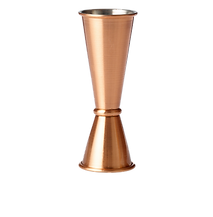
A stainless steel measuring tool used to portion spirits, citrus, syrups, liqueurs, and modifiers accurately for consistent cocktail execution.
Measuring / Pour Control

What It's For
A jigger is used to measure cocktail ingredients accurately before they go into a shaker tin, mixing glass, glass, or build vessel.
It is one of the most important tools behind consistent cocktails because it controls the actual recipe, not just the technique.
Use it for spirits, liqueurs, citrus juice, syrups, vermouths, modifiers, and any ingredient where the spec needs to be repeatable from bartender to bartender.
Why It Matters
A jigger helps bartenders protect consistency, balance, cost, and training standards.
Without accurate measuring, the same cocktail can taste different from bartender to bartender. One bartender may overpour the base spirit, another may under-measure citrus, and another may guess on syrup. That creates inconsistent drinks, inconsistent cost, and inconsistent guest experience.
For LMA programs, the jigger matters because specs only work if the team measures them the same way. The goal is not slow, fussy bartending. The goal is fast, clean, repeatable measuring that keeps every drink inside the intended structure.
_edited.png)
LMA Standard

Use a professional stainless steel jigger with clear measurement markings and a practical 2 oz / 1 oz format.
The preferred setup is a slim Japanese-style or similarly precise jigger that includes common cocktail increments such as 0.25 oz, 0.5 oz, 0.75 oz, 1 oz, 1.5 oz, and 2 oz.
Every active bar station should have its own jigger, and bartenders should use it for all cocktail specs unless a specific batching or controlled-pour system has been approved.
Free-pouring should not be the default standard for LMA cocktail programs. Measuring is part of how the bar keeps drinks consistent.
What To Look For

Clear, readable measurement markings
¼ oz measurement capability
1 oz and 2 oz sides
Stainless steel construction
Comfortable hand feel
Stable balance
Easy pour lip
Interior markings that are easy to see during service
Dishwasher-safe or easy-to-clean material
Durable enough for repeated commercial use
A strong jigger should make accurate measuring feel faster, not slower.

What to Avoid
Unmarked jiggers
Cheap novelty jiggers
Jiggers with confusing or hard-to-read lines
Jiggers that do not include useful cocktail increments
Decorative finishes that wear quickly
Tiny jiggers that slow down service
Large awkward measuring cups for active cocktail wells
Free-pouring without training, testing, or an approved standard
Avoid any jigger that forces bartenders to guess

Recommended
Quantity
2 jiggers per active bar station
Better working setup:
3–4 jiggers per active well
High-volume bars may need more depending on the number of bartenders, number of active wells, and how many cocktails are being built at the same time.
At minimum, bartenders should be able to grab a clean jigger without searching for one during service.
Best Uses

Measuring spirits
Measuring citrus juice
Measuring syrups
Measuring liqueurs
Measuring vermouths
Building shaken cocktails
Building stirred cocktails
Training new bartenders
Maintaining cocktail consistency
Keeping pours consistent
Common examples:
Margarita
Daiquiri
Whiskey Sour
Old Fashioned
Manhattan
Negroni
Mai Tai
Cosmopolitan
Espresso Martini
Signature cocktails
Cleaning &
Maintenance

Rinse jiggers frequently during service, especially after measuring citrus, syrup, cream, egg white, or sticky liqueurs.
Wash and sanitize at the end of every shift.
Do not let sugar, citrus, or dairy residue dry inside the jigger.
Check regularly for dents, worn markings, rough edges, or finish damage
Replace jiggers once the markings become hard to read or the tool no longer feels reliable during service
Pro Tip
The best jigger is the one bartenders will actually use correctly during a busy shift.
Choose a jigger with clear markings, comfortable balance, and the common increments your specs actually require. For LMA-style cocktail programs, ¼ oz capability matters because small differences in citrus, syrup, liqueur, and modifiers can change the entire drink.
Teach the team to measure cleanly, pour with control, and return the jigger to the same station position every time. Speed comes from repetition, not guessing.

Common Mistakes
Free-pouring when the program is built on specs
Using the wrong side of the jigger
Guessing between measurement lines
Measuring above the intended line
Not reading the jigger at eye level when accuracy matters
Using jiggers with no ¼ oz capability
Using dirty or sticky jiggers during service
Not having enough jiggers at the station
Assuming every jigger reads the same way
Teaching recipes without showing the team how to measure them correctly
